r = -0.71Med
Energy dip ↔ Ferritin
Requires clinician review.
213
Biomarkers
12
Specialist modules
1
Connected picture per family
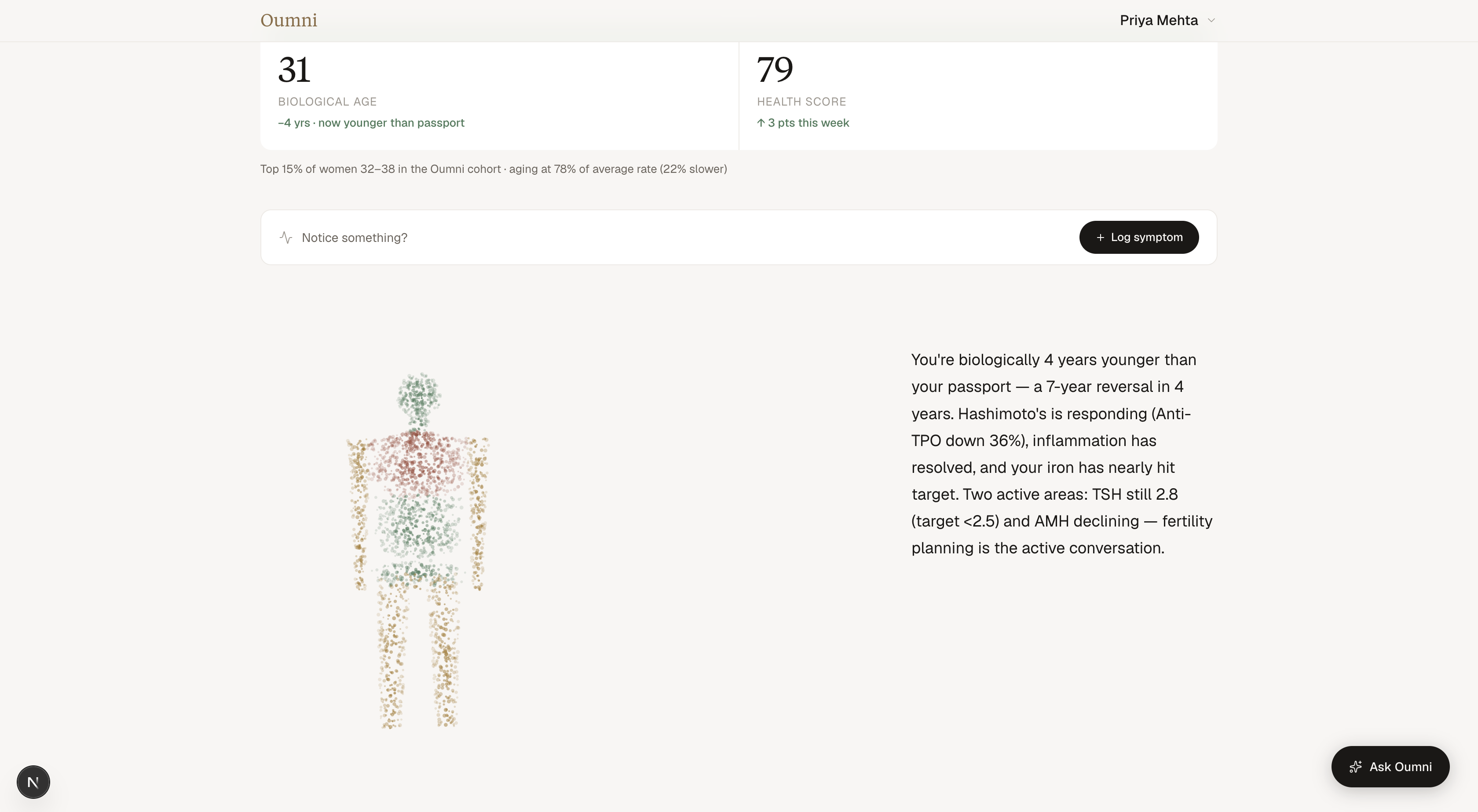
The digital twin maps every biomarker to the right organ system — so doctors see exactly where to look.
Specialist modules
An early-warning system for cardiac events, watching across sleep, blood and wearable signals.
Detecting risk-state drift before a clinical event occurs.
Ten further modules span metabolic, hormonal, renal, hepatic and reproductive systems.
Oumni OS
Five integrated simulators. Patient-paired. Family-linked. India-native. Citation-graded.
Oumni OS is the intelligence and orchestration layer behind Oumni — designed to connect fragmented records, biomarkers, symptoms, family context, care plans, and clinician workflows into one longitudinal decision surface.
The Question
Standard care is sequential, single-domain, and reactive. A person may move from a GP to a gynaecologist to a cardiologist to a diagnostic lab — each working with partial records and limited context.
Oumni OS is designed to connect those moments into a single decision surface, bringing together biomarker, behavioural, environmental, family, and clinical context for care teams to review.
Each visit holds partial context. Records sit in silos. Continuity depends on the patient remembering everything.
60 Seconds of Proof
Patient A. 35F. Hashimoto's · active fertility window.
In the prototype review, Oumni OS is designed to bring multiple signals into one view — thyroid context, fertility timing, iron stores, cardiovascular markers, mood signals, and care goals.
35F · Member 4 years
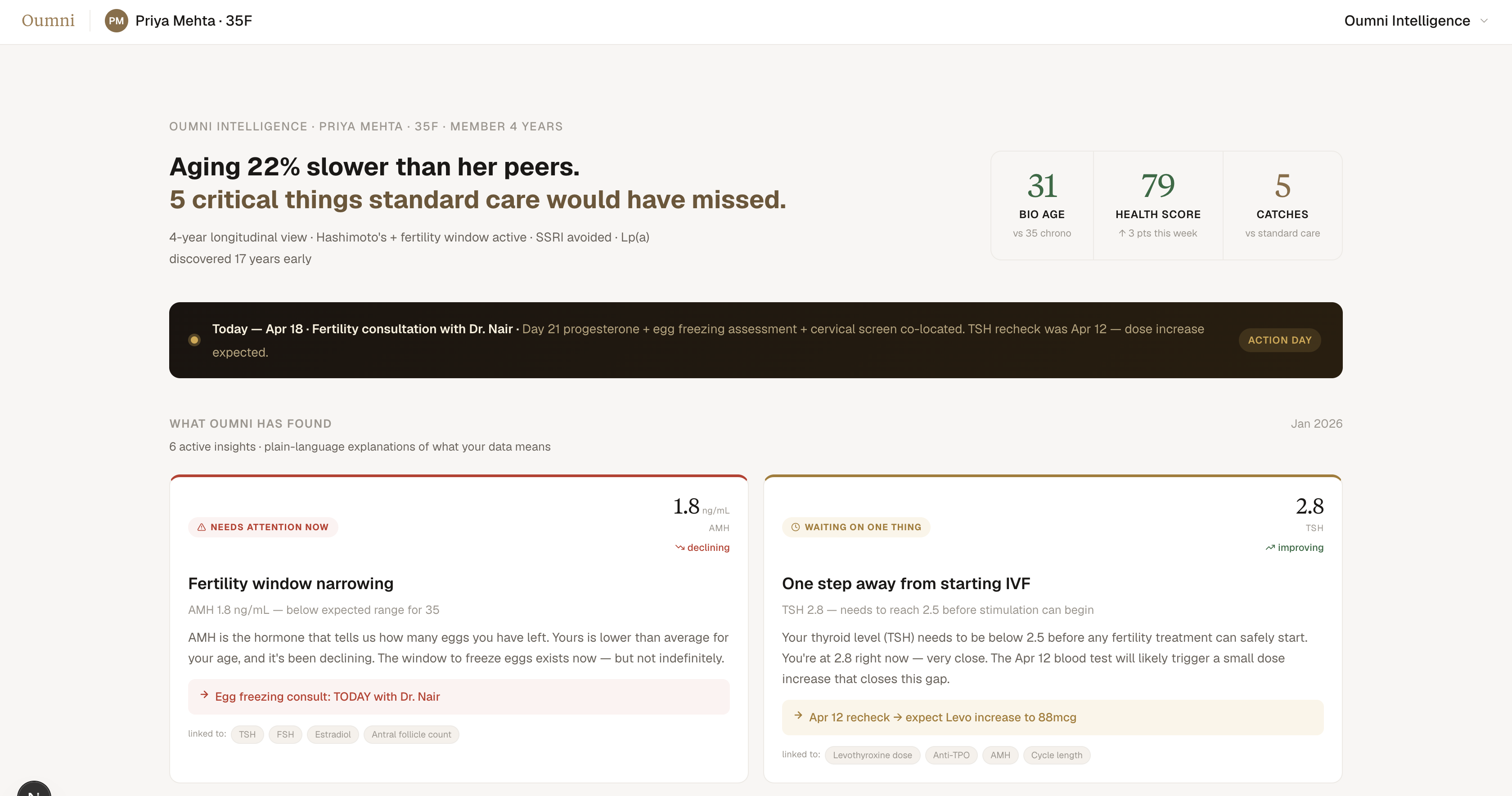
Illustrative case. Modelled outcomes shown for product demonstration only. Not a population-level claim.
A Specific Case · The Catch
PHQ-9 indicates mild symptoms. Without integrated thyroid context, the underlying driver may remain outside the consultation.
Oumni OS can bring PHQ-9 trends and thyroid markers into the same review surface, helping the care team examine whether thyroid status may be contributing to mood changes.
The system can surface and group signals for review. Clinical judgment, diagnosis, and next steps remain with the treating physician.
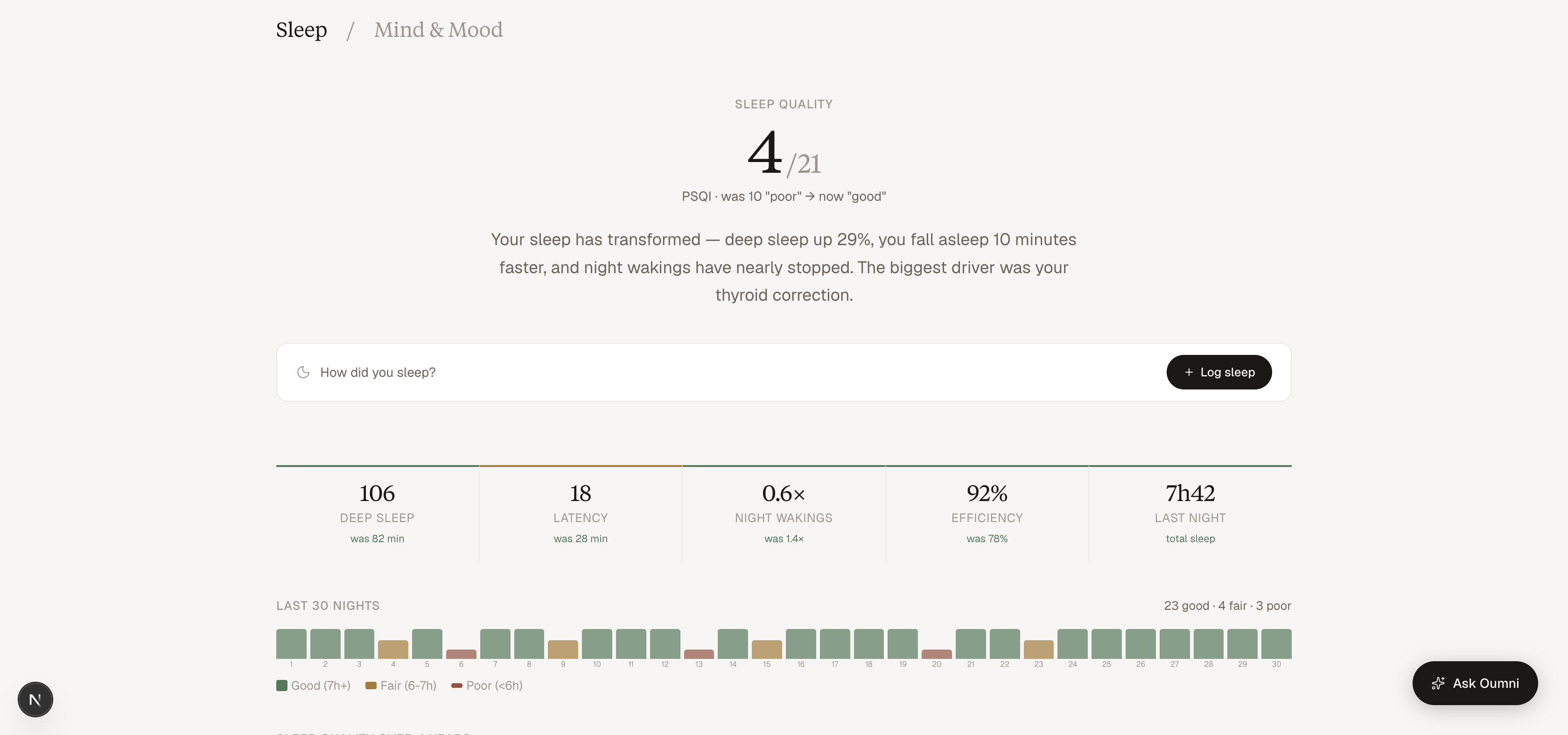
“Your sleep has transformed — deep sleep up 29%. The biggest driver was your thyroid correction.”
Illustrative narrative from the member view, generated from the same longitudinal record the care team sees. Plain-language explanation supports member understanding — not a treatment claim.
What Standard Care Would Have Missed
Each signal may be visible somewhere. The problem is that they are rarely organised together.
AMH trajectory matters more than a single result.
Thyroid preparation may need review before stimulation.
Mood trends and thyroid markers can be reviewed together.
Genetic and biomarker signals can be brought into preventive review.
Response can be tracked against adherence and time.
Why This Is Different
Many healthcare tools operate in a single domain: radiology, ECG triage, nutrition, e-pharmacy, metabolic care, or longitudinal labs. Oumni OS is being built as an integrated simulation and orchestration layer across multiple dimensions of the same person.
The Architecture
Each tier earns its right to exist by what it adds. Different audiences, the same underlying patient record.
For member and family
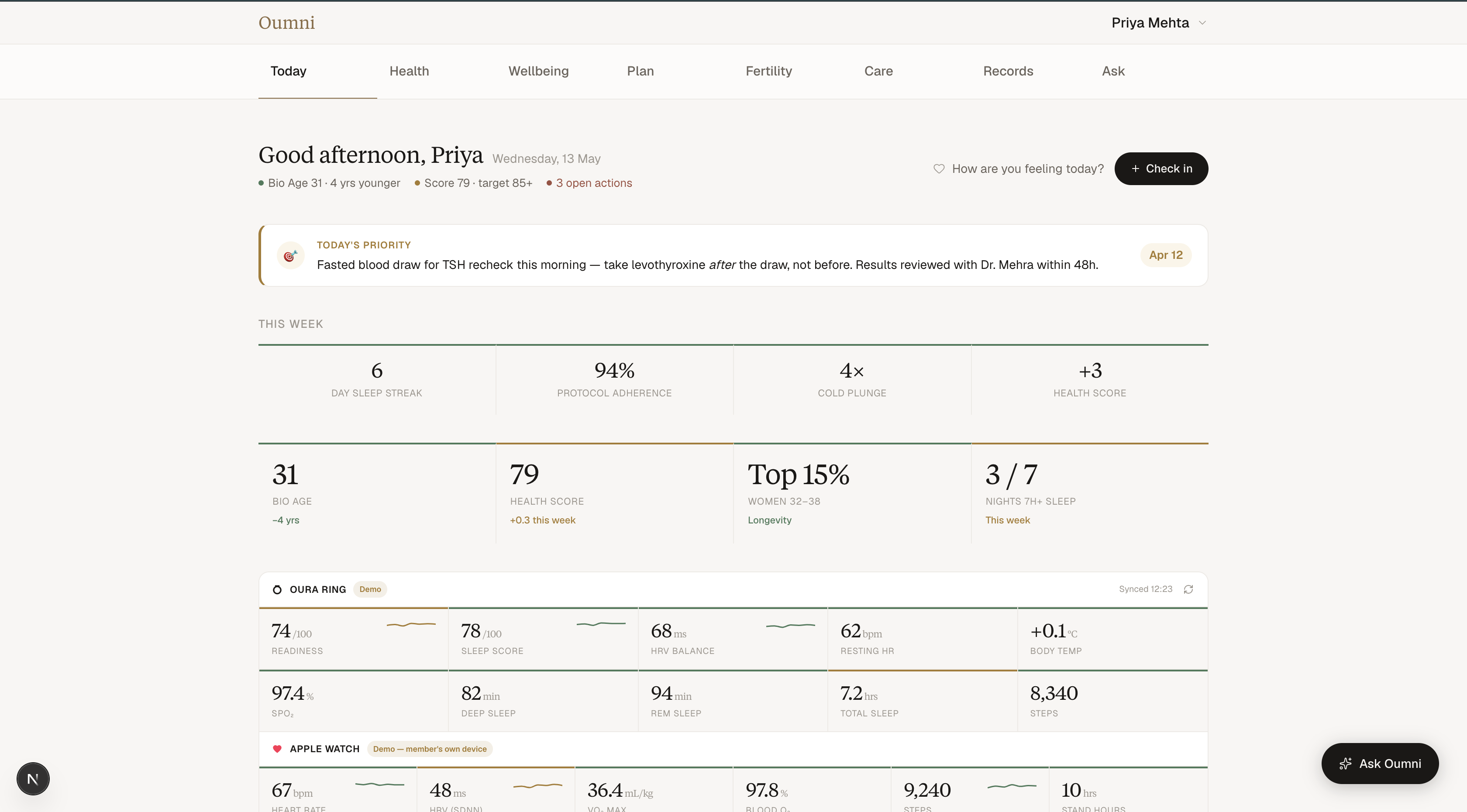
Patient-readable narrative: Today, Health, Wellbeing, Plan, Fertility, Care, Records.
For care coordinators, pharmacists, and allied health
Profile-aware product checking, family-linked records, Indian environmental and regulatory inputs.
For clinicians and care teams
Five simulators, predictive risk, root-cause review, citation-graded research module.
For annual reviews, strategic partners, and longitudinal proof
Outcomes narrative, case studies, retention insights, stakeholder-ready evidence.
Today, Health, Wellbeing, Plan, Fertility, Care, Records. Plain language. Longitudinal context. Same record as the care team — different lens.
The Simulation Engine
Patient-paired. Family-linked. Outputs flow back into one longitudinal record so pathways can be compared, simulated, and reviewed together.
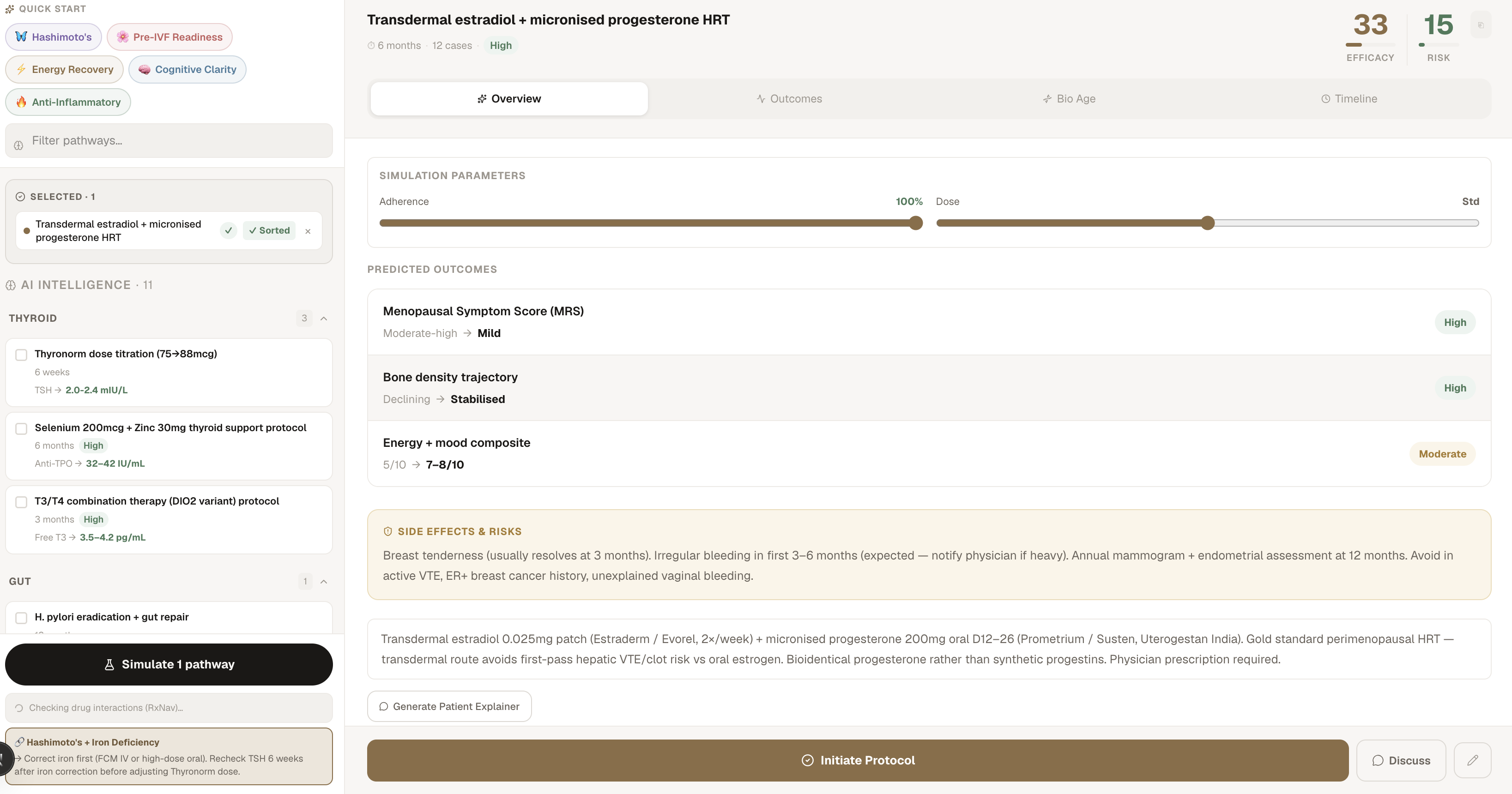
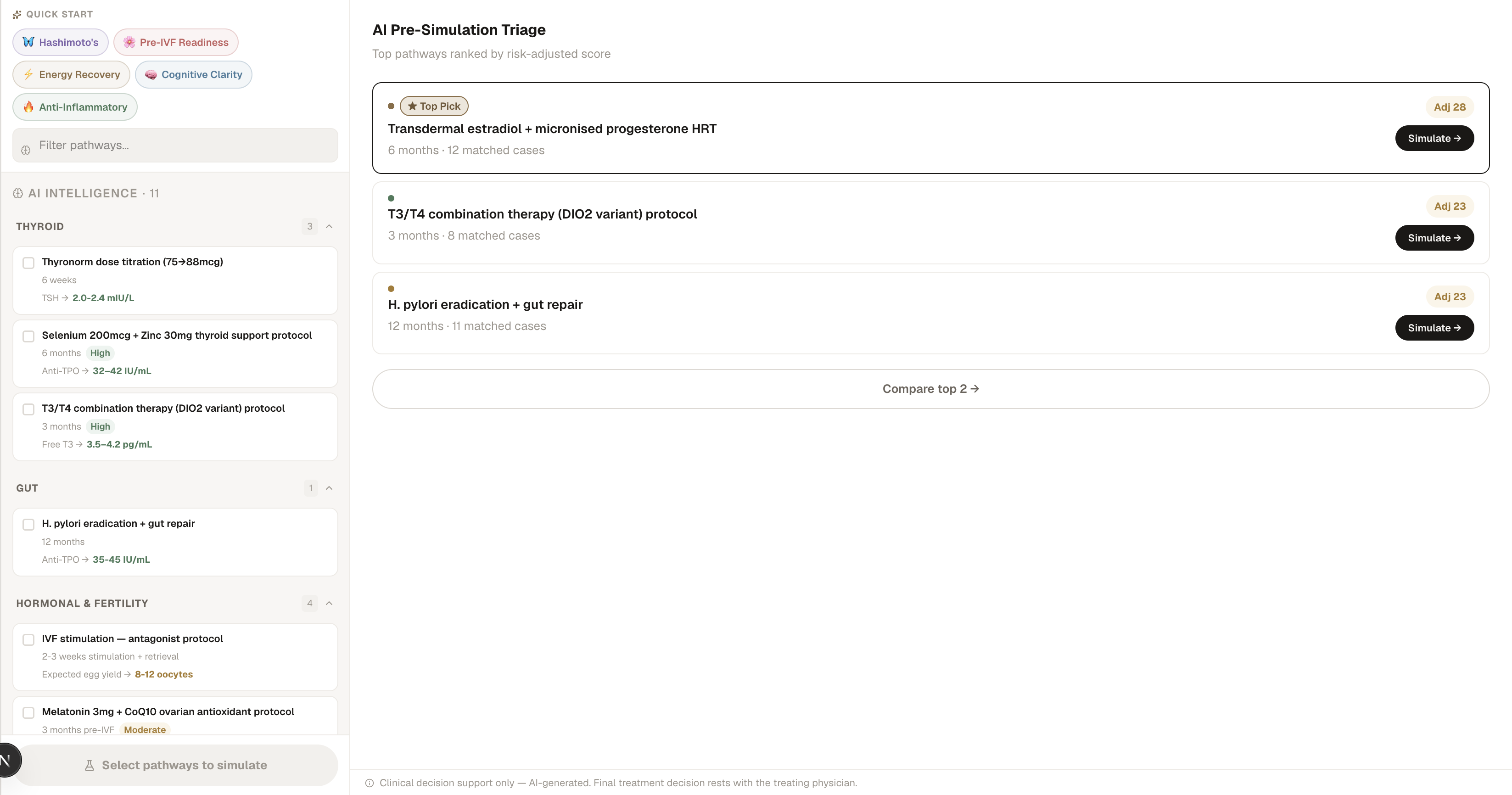
The system ranks candidate pathways by a risk-adjusted score and presents them for clinician review. Each candidate carries its own efficacy and risk estimates, matched cases, and time horizon.
Clinical decision support only. Final treatment decision rests with the treating physician.
Technical Moat · N-of-1
Standard care often sees only the outcome. Oumni OS is designed to separate observed progress from adherence-adjusted response, helping care teams distinguish between an ineffective pathway and an adherence gap.
Slow improvement could mean the protocol is wrong — or that adherence was 40%, not 95%.
Estimates response in the context of adherence and observed data, surfaced for clinician review.
A protocol change, coaching, review, or follow-through. The right action depends on the right reason.
Causal Reasoning · N-of-1 Signal Discovery
Oumni OS is designed to support personalised statistical reasoning over time. Confidence can improve as more data points are added, helping care teams review symptom and biomarker relationships in context.
Requires clinician review.
Requires clinician review.
Requires clinician review.
Requires clinician review.
Localization = Moat
Indian healthcare is fragmented across labs, hospitals, pharmacies, family decision-makers, paper records, WhatsApp coordination, Indian drug rules, local food patterns, and environmental realities. Oumni OS is being built for this reality from day one.
Indian diagnostic networks: Thyrocare, SRL, Metropolis, Apollo, Fortis, Max.
CDSCO scheduling awareness and Indian drug schedules.
Cultural staples in the food checker — roti and wheat/gluten context.
Delhi heat, AQI, hard water, and UV exposure.
Mother–child and family-linked records where consented.
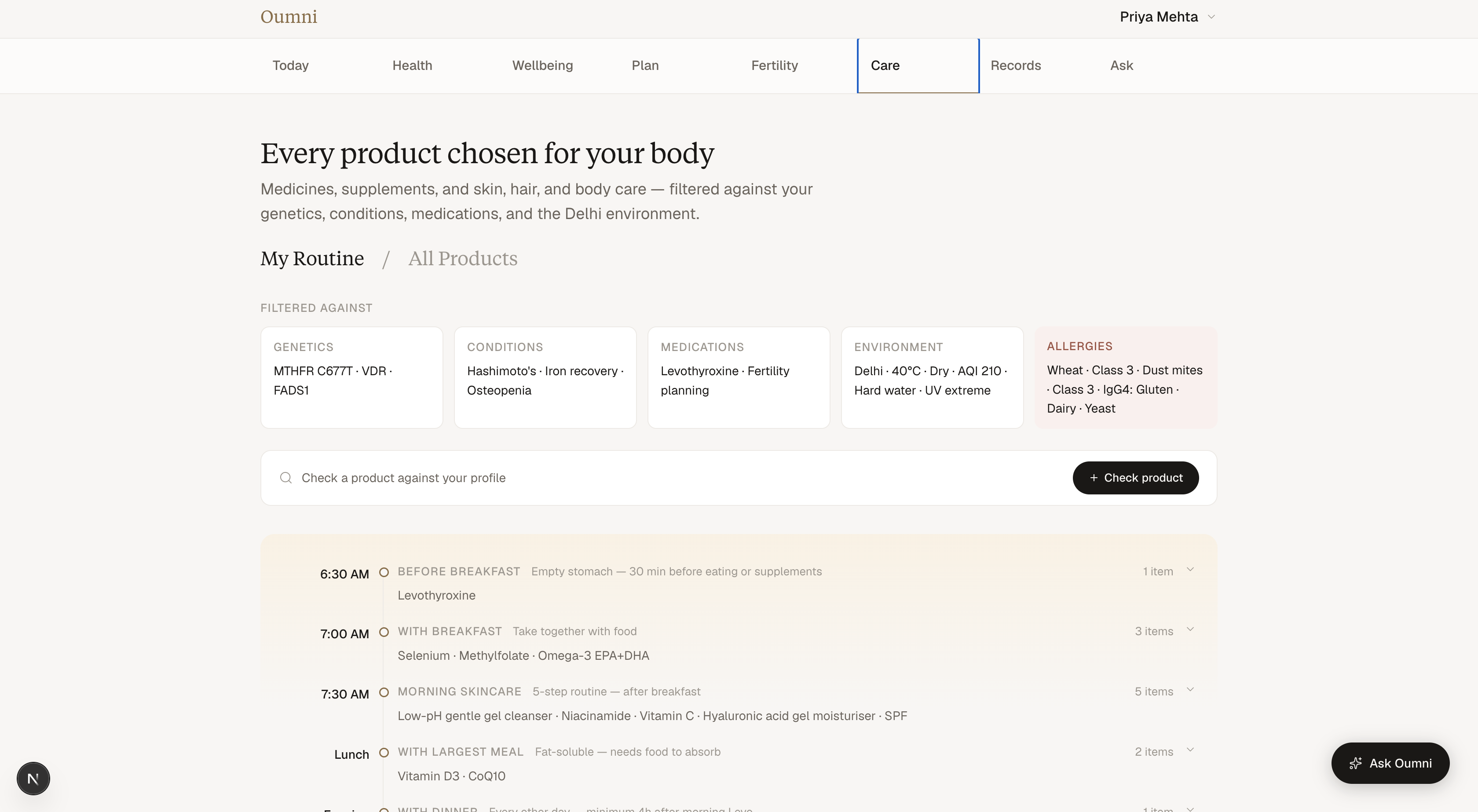
The system flags it for review against the member's wheat / gluten context, alongside Delhi AQI, hard water, and active medications. Contextual, not generic wellness advice.
One Patient · Multiple Lenses
The data is shared. The role-specific dashboard is not. Oumni OS is designed so different care roles can work from the same underlying patient context while seeing the lens relevant to their work.
What We Are Rebuilding
Simulators surface ranked clinical pathways with confidence intervals.
Treating physician validates, modifies, or rejects. Final decision rests with the clinician.
AccountableEach decision and outcome improves the simulation cycle over time.
Clinician-facing intelligence prototype
Clinical co-pilot
Regulated medical intelligence layer
OS for caregivers and autonomous care workflows
Oumni is not claiming autonomous medicine today. The current product is a prototype designed to support clinician review.
Trust Architecture
Care teams remain accountable for clinical decisions.
Research and recommendations should be traceable to source quality.
Family-linked and patient-paired records require explicit permission.
Prototype capabilities should be labelled clearly until validated and regulated.
The goal is not autonomous medicine. The goal is better-prepared human care.
Continuous Care · Continuous Intelligence
Five integrated simulators. Patient-paired. Family-linked. India-native. Citation-graded.
Oumni OS is being built as the intelligence layer behind continuous care — connecting records, context, simulation, clinician review, and follow-through into one longitudinal system.